DREAM 2020: Disentangled Representations for Efficient Algorithms for Medical data
At MICCAI 2020, we introduce and motivate the use of disentangled representations in medical imaging and present the latest methods.
← Back to TutorialsA MICCAI 2020 (Peru) Tutorial by Sotirios A. Tsaftaris and Alison Q. O’Neil.

Outline
Disentangled representation learning has been proposed as an approach to learning general representations. This can be done in the absence of annotations, or with limited annotation. A good general representation can be readily fine-tuned for new target tasks using modest amounts of data. This alleviation of the data and annotation requirements offers tantalising prospects for tractable and affordable healthcare. Finally, disentangled representations can offer model explainability, increasing their suitability for real-world deployment.
In this half-day tutorial, a satellite event in conjunction with MICCAI 2020 (Peru), we will offer an overview of representation learning and disentangled representation learning and criteria, and discuss applications in medical imaging and the wider spectrum of EHR data. We will conclude with open ended challenges.
Program
Virtual Format: On the MICCAI platform we have uploaded several videos that cover the material of the tutorial. Please send us your questions before the session via email or via the platform. On the day of the tutorial, we will be offering an abridged version of the pre-recorded video material currently available on the platform LIVE to further develop audience interaction and ensure that everyone in the audience is on a level playing field. We will divide the tutorial in sessions, keep each session short, and have live Q&A immediately after each session.
All times are UTC (for BST (current UK time), add +1).
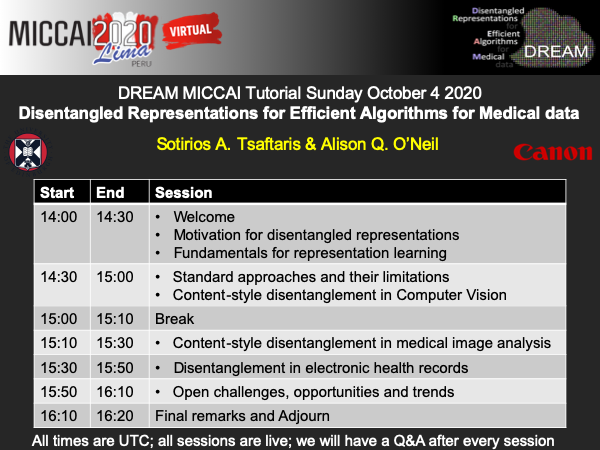
Learning Objectives
- Understand representation space and why (in)variance matters
- Understand the theories of information bottleneck and compositionality
- Learn the different objectives in achieving disentanglement
- Appreciate the inductive biases introduced by network design choices
- Appreciate when disentanglement is useful in practice
Motivation
Imagine that we want to develop a system that localises the heart in MRI and CT images. This system will need to be robust to any changes in imaging, the scanner, noise, and critically anatomical and pathological variation. The current paradigm with deep learning is that we must present to the system as many examples as possible to make it robust and learn what is nuisance (e.g. noise and imaging differences) as opposed to what matters (e.g. the location of the heart).
Clearly this is not sustainable and leads to poor performance. Disentangled learning can help because it allows us to learn latent factors that can describe what we see in the data. Surprisingly we do not always need annotated data to achieve this. Moreover, it has been shown that disentangled representations are privacy preserving; can offer explainability and interpretability; and can generalise to new tasks (meta-learning) and to new data sources with less effort.
Teachers
Prof. Sotirios A Tsaftaris (Sotos) is Chair in Machine Learning and Computer Vision with the University of Edinburgh and is also the Canon Medical/Royal Academy of Engineering Research Chair in Healthcare AI. Sotos leads a group where several young researchers work in machine learning and computer vision. He obtained his PhD in 2006 from Northwestern University USA and has held several academic positions in USA, Italy and UK. Sotos’s research expertise is in representation learning.
Dr Alison Q O’Neil (Alison) is a Senior Scientist in the AI Research Team at Canon Medical Research Europe and Honorary Research Fellow at the University of Edinburgh. She obtained her EngD at Canon Medical Research Europe in affiliation with Heriot-Watt University, and now leads a team of scientists and research students working on machine learning techniques for industrial healthcare applications – including applications in medical imaging, natural language processing, and electronic health record (EHR) data.
Materials
See MICCAI platform.
Support
Generously supported by Canon Medical Research Europe, the Royal Academy of Engineering and the School of Engineering.